


16.12.2015
Press Club on "Climate Change - Addressing the post COP21"
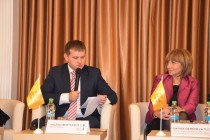
The phenomenon of climate change is of a daily basis, practically in all countries of the world. Republic of Moldova is not an exception. Ms. Dafina Gercheva, the UN Resident Coordinator / UNDP Resident Representative in Moldova, along with the members of ministerial delegations, led by Mr. Valeriu Munteanu, the minister of the Ministry of Environment talked about the global and national commitments following the adoption of the Paris Agreement on 12th of December 2015, at a press club dedicated to climate change.
The Press Club "Climate Change – COP21 post approach" was organized by the NGO Association of Journalists for Environmental and Ecological Tourism from Republic of Moldova (AJMTEM) in partnership with the Small Grants Program of the Global Environment Facility, UNDP Moldova and Ministry of Environment. In the press club, there were invited Ms. Dafina Gercheva, UN Resident Coordinator / UNDP Resident Representative; Mr. Valeriu Munteanu, the minister of Ministry of Environment; Ms. Inga Podoroghin, Head of Department for Analysis, Monitoring and Evaluation of Policies, Ministry of Environment; Ms. Stela Drucioc, manager of the Office of Carbon Financing, Ministry of Environment; Mr. Vasile Scorpan; manager of Climate Change Office, Ministry of Environment.
Ms. Dafina Gercheva, the UN Resident Coordinator / UNDP Resident Representative, noted that "Climate change is different from other challenges. The damage is irreversible. Glaciers melt can not be re-frozen, extinct species can not be revived and neighboring areas flooded can not be reconstructed exactly as they were. Action on climate change is more urgent than anything else", thus being mentioned that the Agreement represents a triumph of democracy, and compared it with an "insurance policy for the planet". The 2015 year proved to be an unprecedented opportunity for the world to change its way, by adopting an inclusive development path, sustainable and resilient.
In line with the undertaken commitments, Mr. Valeriu Munteanu, the minister of Ministry of Environment, mentioned that Moldova has two ways in reducing the pollution index. The first one – the unconditional reduction with planned policies, which consist in reducing the emissions of greenhouse gases by 64%-67% compared to year 1990; and the second one – the conditional reduction, which consist in reducing the emissions of greenhouse gases by 80%. In both cases, the country will need substantial financial support in the amount of 1.3 and 3.7 billion US dollars for the period 2016-2020, and 4-8.6 billion US dollars for the period 2020-2030.
Even if the agreement is considered as an historical one, Mr. Vasile Scorpan, the manager of Climate Change Office, explained that it does not provide penalty mechanisms if one of the signatory states is not fulfilling its obligations and has no method of stimulating the countries that are respecting their undertaken commitments. But, it is in the interest of every country to reduce emissions of greenhouse gases to save the planet.
Although, Moldova does not have a high pollution index relative to the global situation, it is directly affected by climate change. Among the risks affecting the country, mentioned Mr. Vasile Scorpan, it should be listed: lack of drinking water, drying indigenous tree species, extinction of fauna and flora species, desertification, decreased agricultural production and others.
About 60% of greenhouse emissions are caused by thermic energy, electricity and transport, on the second place – the growing agriculture with 10-12%, the industry produces about 10% of emissions, and environmental waste are covering 8-10%.
A way of reducing these risks would be to increase forest area, to diversify the energy sources. One of the biggest issues is the unauthorized waste. In Moldova, there are only two authorized waste places, from Balti city, and Tintareni village, Anenii Noi district, which together emit 8-10 % greenhouse gases.
The Paris Agreement will be signed on April 22, 2016, on the Earth Day, in New York. Signing procedure will last until April 21, 2017, then each state will have to ratify the agreement at a national level. The process will take place till 2020.
The document is based on provisions that will help mitigate - reduce emissions, fast enough to reach the target temperature; and create a global uptake stock for combating climate change; adapt the capacity of countries to deal with climate change; to strengthen the recovery capacity as a result of climate change; to support – including financially.
For more details.


